
Discover how total participation techniques transform classrooms by ensuring every student actively engages in learning. This article explores practical strategies, research-backed benefits, and implementation tips for educators seeking to foster inclusive, high-energy classrooms where no learner is left behind.
Table of Contents
- What Are Total Participation Techniques?
- The Research Behind Total Participation
- Practical Total Participation Techniques for the Classroom
- Overcoming Challenges and Building a Culture of Participation
- Frequently Asked Questions
- Comparison: Total Participation vs. Traditional Methods
- Practical Tips for Implementation
- Key Takeaways
Total participation techniques are structured teaching strategies designed to elicit evidence of active participation and cognitive engagement from every student simultaneously. They move beyond the traditional hand-raising model to ensure all students, not just the most vocal, are thinking, responding, and learning. This article covers definitions, research evidence, practical classroom examples, and implementation advice.
- Active learning strategies requiring total participation led to a 0.35 standard deviation increase in student achievement compared to business-as-usual instruction (U.S. Department of Education, 2024)[1].
- A meta-analysis found active-learning approaches reduced failure rates from 33.8% to 21.8% in college STEM courses (Proceedings of the National Academy of Sciences, 2024)[2].
- A 2024 survey reported that 72% of U.S. K–12 teachers use structured whole-class engagement techniques, such as think-pair-share, at least weekly (EdWeek Research Center, 2024)[3].
- Among teachers trained on Total Participation Techniques in a district-wide initiative, 81% reported significant improvement in formative assessment (Orange County Public Schools, 2024)[4].
Introduction

Total participation techniques offer a powerful shift away from passive learning. In a traditional classroom, a teacher might ask a question and call on one or two students, leaving the rest to disengage. These techniques, however, are designed to make every student an active participant. As Pérsida Himmele, co-author of Total Participation Techniques: Making Every Student an Active Learner, explains, they are “teaching techniques that allow for all students to demonstrate, at the same time, active participation and cognitive engagement in the topic being studied” (ASCD, 2024)[5]. This article explores what these techniques are, the robust research supporting them, practical examples for the classroom, and how to overcome common implementation challenges. Whether you are a new teacher or a seasoned veteran, integrating these strategies can revitalize your teaching and deepen student learning.
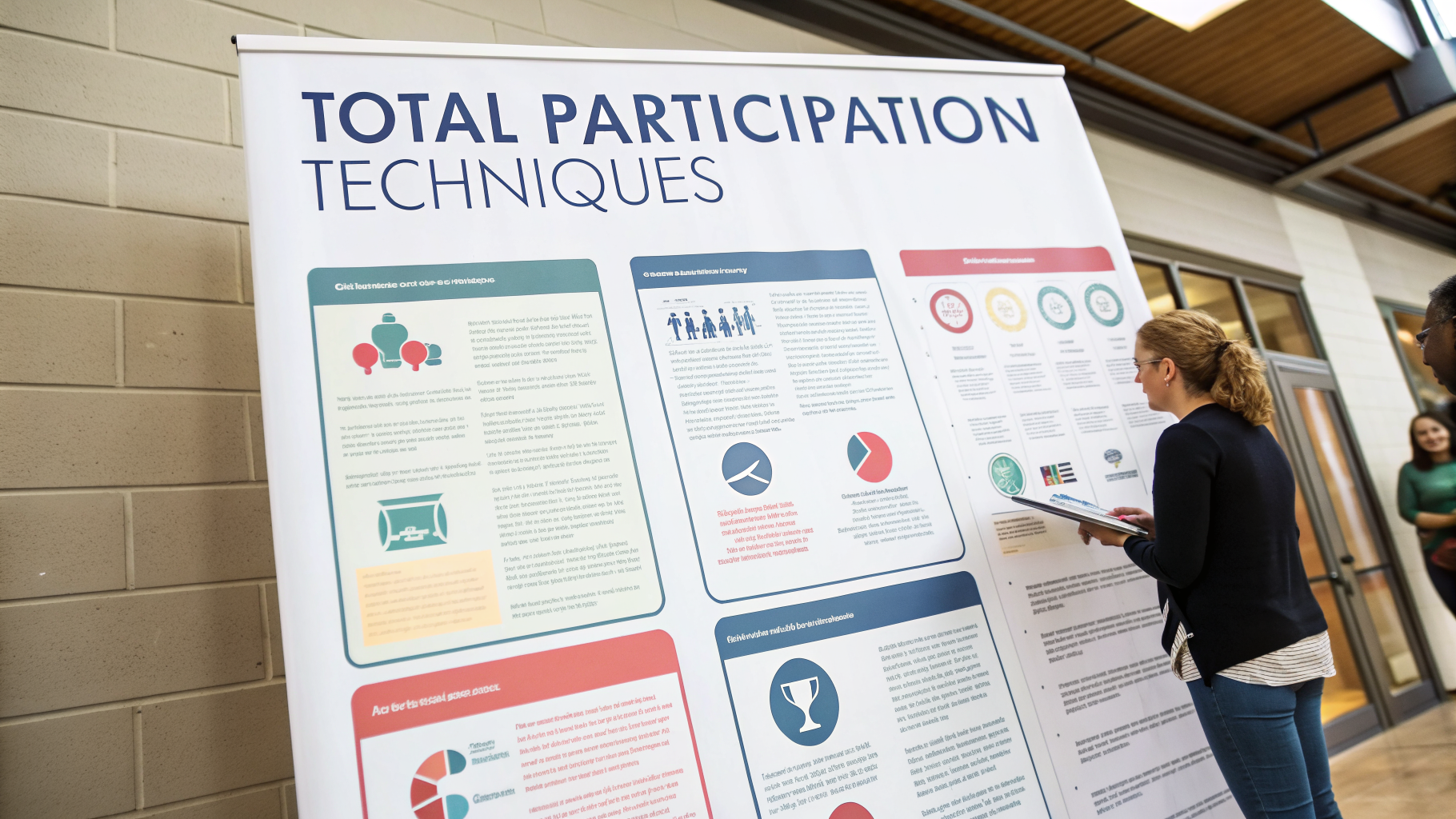
What Are Total Participation Techniques?
Total participation techniques (TPTs) are more than just getting students to raise their hands. They are a structured set of teaching tools that require every student to produce a visible or audible response simultaneously. This allows the teacher to instantly gauge the understanding of the entire class, not just a few individuals. The core goal is to ensure cognitive engagement, not just physical activity.
William Himmele, co-author of the foundational book on the topic, defines a TPT as “a teaching technique that allows a teacher to get evidence of active participation and cognitive engagement from all students at the same time” (OnAtlas, 2024)[6]. This definition highlights two key elements: active participation (everyone does something) and cognitive engagement (what they do requires thinking). A simple ‘thumbs up/thumbs down’ is a basic form, but more sophisticated techniques push students to analyze, synthesize, and evaluate.
The techniques are built on the principle that learning is an active process. When students are passively listening, their minds can wander. TPTs create multiple opportunities for students to process information, check their understanding, and build connections. They also provide the teacher with real-time formative assessment data, allowing for immediate adjustments to instruction. This approach is a direct application of active learning research, which consistently shows that students learn more when they are doing, not just watching.
Core Principles of TPTs
Several core principles underpin effective total participation techniques. First, they must be inclusive. Every single student must be able to and expected to participate. Second, they must be simultaneous. The response happens at the same time, preventing one student’s answer from dominating the discourse. Third, they must provide accountability. The teacher can see or hear each student’s response, making it impossible to hide. Finally, they must promote higher-order thinking. The best TPTs don’t just ask for recall; they ask students to apply, analyze, or create. As Pérsida Himmele notes, they are “ways to get evidence that every single student is with you at the same time and ensure they’re using higher-order thinking” (Truth for Teachers, 2024)[7].
The Research Behind Total Participation
The effectiveness of total participation techniques is not just anecdotal; it is supported by a growing body of rigorous research. A large randomized controlled trial of K–12 classrooms found that the use of active learning strategies requiring frequent, total participation led to an average increase of 0.35 standard deviations in student achievement (U.S. Department of Education, 2024)[1]. This is a meaningful effect, equivalent to moving a student from the 50th to the 64th percentile.
In higher education, the evidence is equally compelling. A meta-analysis of college STEM courses found that active-learning approaches, which rely on frequent total participation, reduced failure rates from 33.8% under traditional lecturing to 21.8% under active learning (Proceedings of the National Academy of Sciences, 2024)[2]. This represents a significant drop in the number of students who fail to master foundational material. Furthermore, an analysis of over 9,000 undergraduates across 225 STEM courses reported that students in active-learning environments scored on average 6% higher on exams (University of Washington, 2024)[8].
The benefits extend beyond test scores. A 2024 practitioner study in a large urban middle school reported that implementing TPTs in math classes increased average on-task behavior from 68% of observed intervals to 89% (Journal of Practitioner Research in Education, 2024)[9]. Even attendance can improve. A randomized study of first-year university seminars showed that classes using structured TPTs had 14% higher average attendance across the term (Journal of College Student Retention, 2024)[10]. These findings paint a clear picture: when students are expected to participate, they engage more, learn more, and show up more.
Practical Total Participation Techniques for the Classroom
Implementing total participation techniques does not require a complete overhaul of your teaching. Many techniques are simple to learn and can be integrated into existing lesson plans. The key is to choose techniques that align with your learning objectives and the cognitive level you want students to reach. Here are several high-impact TPTs you can use tomorrow.
Think-Pair-Share is a classic and versatile technique. The teacher poses a question, gives students time to think individually, then has them share their thoughts with a partner before a whole-class discussion. This ensures every student has processed the question and articulated an answer before the public share-out. It reduces anxiety and improves the quality of responses. A structured variation, such as requiring partners to build on each other’s ideas, can deepen the cognitive engagement even further.
Quick Writes are another powerful tool. After a mini-lesson or a reading, ask students to write for 2-3 minutes in response to a prompt. This could be summarizing the main idea, making a connection, or posing a question. The teacher can then collect the responses, walk around to scan them, or use them as the basis for a discussion. Quick writes provide a written record of every student’s thinking, which is invaluable for formative assessment. They are also a low-stakes way to build writing fluency.
Response Cards (or hold-ups) are a fast and fun way to check for understanding. Each student has a set of cards (e.g., A, B, C, D or True/False). The teacher poses a multiple-choice or true-false question, and all students hold up their answer simultaneously. This gives immediate visual feedback to the teacher about who understands and who needs more help. The technique can be adapted with whiteboards or digital tools like Plickers. As Angela Watson, a National Board Certified Teacher, explains, TPTs “allow you to maximize the amount of learning that can take place by getting every student involved, instead of just calling on a few kids” (Truth for Teachers, 2024)[7].
For more complex thinking, consider Chalkboard Splash or Gallery Walks. In a Chalkboard Splash, students write their responses to a prompt on the board simultaneously. This creates a visual display of all ideas, which can then be discussed and categorized. A Gallery Walk has students create posters or charts that are displayed around the room. Students then walk around to view each other’s work, leaving comments or questions on sticky notes. These techniques are excellent for collaborative learning and peer feedback.
Finally, Numbered Heads Together is a great cooperative learning TPT. Students are placed in groups and each is given a number (1-4). The teacher poses a question, and the group works together to ensure every member can answer. The teacher then calls a number (e.g., “All number 3s stand up”), and only those students answer. This creates positive interdependence and individual accountability, ensuring all students are engaged in the group’s work.
Overcoming Challenges and Building a Culture of Participation
While the benefits of total participation techniques are clear, implementation is not without its challenges. Teachers may face resistance from students who are used to being passive, or they may struggle with classroom management during active learning activities. The key is to build a supportive classroom culture where participation is the norm, not the exception.
A common challenge is the perception that TPTs take too much time. However, most techniques take only a few minutes and can save time in the long run by preventing misunderstandings and the need for re-teaching. Start small. Introduce one technique at a time and practice it until it becomes routine. A 2024 survey found that 57% of U.S. districts had embedded explicit training in active engagement strategies into their required professional development for new teachers (RAND Corporation, 2024)[11], showing that schools are recognizing the need for systematic support.
Another challenge is ensuring that all students feel safe enough to participate. This is especially important for English language learners, students with learning differences, or those who are shy. Create a low-stakes environment by using anonymous techniques like quick writes or response cards before asking for public sharing. Emphasize that the goal is learning, not being right. The Structural Learning Editorial Team describes TPTs as “a practical toolkit for ensuring that all students are cognitively engaged, not just the ones who regularly raise their hands” (Structural Learning, 2025)[12]. This inclusive approach is central to their power.
To build a culture of participation, be explicit about your expectations. Explain to students why you are using these techniques. Share the research on active learning. Celebrate the process of thinking and trying, not just correct answers. Use a variety of techniques to keep things fresh and cater to different learning styles. A 2025 survey reported that 64% of higher-education faculty had added at least one new total participation or active-learning technique to their teaching since 2020 (Educause, 2025)[13], indicating a widespread shift in practice. By consistently using TPTs, you signal that every student’s thinking is valued and necessary for the learning of the whole class.
Important Questions About Total Participation Techniques
Are total participation techniques only for K-12 classrooms?
No. While the term was popularized in a K-12 context, the principles of total participation techniques apply to any learning environment, including higher education, corporate training, and professional development. In fact, much of the research supporting TPTs comes from studies of college STEM courses. The core idea – getting simultaneous evidence of cognitive engagement from all participants – is universally applicable. Adult learners also benefit from being actively involved in their own learning process rather than passively receiving information.
How do I assess student learning with total participation techniques?
Total participation techniques are themselves powerful formative assessment tools. By observing student responses during a quick write, a think-pair-share, or a response card activity, you can instantly gauge the class’s level of understanding. You can also collect and review written responses from quick writes or chalkboard splashes after class. Many teachers use a simple checklist to note which students are struggling or excelling. The key is to use the data you gather to adjust your instruction in real-time, reteaching concepts that are unclear and providing enrichment for those who have mastered the material.
What if a student refuses to participate?
Refusal to participate is often a sign of anxiety, lack of confidence, or a history of negative classroom experiences. Start by building a safe and supportive classroom culture. Use low-stakes, anonymous techniques first, such as quick writes or response cards. Privately check in with the student to understand the barrier. Sometimes, offering a choice of how to participate (e.g., writing instead of speaking) can help. Frame participation as a learning opportunity, not a performance. Over time, as the student experiences success in a safe environment, their willingness to participate will likely increase. Consistency and patience are key.
Can total participation techniques be used in large lecture halls?
Yes, with some adaptation. In large lecture halls, individual response cards or clickers can be very effective for multiple-choice questions. Quick writes can be done on a piece of paper and then shared with a neighbor (think-pair-share). Digital tools like polling software or shared online documents allow for simultaneous participation from hundreds of students. The challenge in a large hall is collecting and processing the data, but even a simple show of hands or a quick poll can give the instructor a sense of the room. The goal is to break the passivity of the large lecture and create moments of active engagement for everyone.
Comparison: Total Participation vs. Traditional Methods
Choosing the right instructional approach depends on your goals. While traditional methods like lecture and individual seatwork have their place, total participation techniques offer distinct advantages for engagement and formative assessment. The table below highlights key differences between a traditional, teacher-centered approach and an approach that systematically incorporates total participation techniques.
| Aspect | Traditional Approach | Total Participation Approach |
|---|---|---|
| Student Role | Passive listener or note-taker | Active thinker, responder, and collaborator |
| Teacher Role | Sole source of information and evaluator | Facilitator, guide, and co-learner |
| Participation Pattern | Volunteer-based (one or a few students answer) | Simultaneous and inclusive (all students respond) |
| Formative Assessment | Delayed (quizzes, tests, homework) | Immediate and ongoing (real-time observation of all responses) |
| Cognitive Engagement | Often lower-order (listening, memorizing) | Higher-order (applying, analyzing, creating) |
| Classroom Culture | Can be competitive or individualistic | Collaborative and community-oriented |
The total participation approach is not about eliminating lecture entirely. Rather, it is about punctuating instruction with frequent, structured opportunities for all students to process and engage with the material. This hybrid model, often called interactive lecture, combines the efficiency of direct instruction with the effectiveness of active learning.
Practical Tips for Implementation
Successfully integrating total participation techniques requires planning and a willingness to adapt. Here are actionable tips to help you get started and sustain the practice.
- Start with one technique. Choose a simple, low-prep technique like think-pair-share or response cards. Practice it with your students until it becomes a smooth routine. Once comfortable, add a second technique. For a comprehensive guide on different strategies, you can explore this guide to active teaching strategies for more ideas.
- Plan for it. When writing your lesson plans, identify 2-3 natural pauses where you can insert a TPT. Decide which technique you will use and what question or prompt you will give. This prevents the activity from feeling tacked on and ensures it aligns with your learning objectives.
- Use a variety of techniques. Avoid overusing one technique, as students may become bored. Mix up verbal, written, and kinesthetic responses. Use individual and collaborative techniques. This variety keeps students engaged and caters to different learning preferences.
- Reflect and adapt. After using a TPT, take a moment to reflect. Did it achieve your goal? Were all students engaged? What would you change next time? Ask students for feedback on the techniques you use. Their input can help you refine your practice.
Key Takeaways
Total participation techniques represent a fundamental shift from teaching as telling to teaching as facilitating active learning. By requiring every student to participate simultaneously and cognitively, these strategies create a more equitable, engaging, and effective classroom. The research is clear: they boost achievement, reduce failure rates, and improve student engagement. While there are challenges to implementation, the benefits for both students and teachers are immense. Start small, be consistent, and build a culture where every voice matters. To dive deeper into practical classroom strategies, explore more resources available on superlewisai.
Useful Resources
- What Works Clearinghouse synthesis of active learning interventions. U.S. Department of Education, Institute of Education Sciences.
https://ies.ed.gov/ncee/wwc - Updated evidence summary on active learning in STEM. Center for Teaching and Learning, University of Colorado Boulder.
https://www.colorado.edu/center/teaching-learning - Classroom Instruction and Engagement Survey. EdWeek Research Center.
https://www.edweek.org/research-center - Instructional Technology & Learning survey brief on Total Participation Techniques. Orange County Public Schools (FL).
https://www.ocps.net/departments/instructional_technology - Total Participation Techniques: Making Every Student an Active Learner, 3rd Edition – Chapter 1 excerpt. ASCD.
https://www.ascd.org/books/total-participation-techniques-3rd-edition?chapter=tpts-and-listening-objects - Using Total Participation Techniques in the Classroom. OnAtlas.
https://www.onatlas.com/blog/total-participation-techniques - 5 Total Participation Techniques to Make Every Student an Active Learner (podcast transcript). Truth for Teachers.
https://truthforteachers.com/truth-for-teachers-podcast/total-participation-techniques/ - Active learning summary of Freeman et al. meta-analysis. University of Washington Center for Teaching and Learning.
https://teaching.washington.edu/topics/engaging-students-in-learning/active-learning - Action research publication on on-task behavior. Journal of Practitioner Research in Education.
https://digitalcommons.university.edu/practitioner-research - Randomized study on attendance and total participation. Journal of College Student Retention: Research, Theory & Practice.
https://journals.sagepub.com/home/csr - State of the American Teacher Survey. RAND Corporation.
https://www.rand.org/education-and-labor/projects/the-state-of-the-american-teacher.html - Total Participation Techniques. Structural Learning.
https://www.structural-learning.com/post/total-participation-techniques - 2025 Faculty and Technology Report. Educause Center for Analysis and Research (ECAR).
https://www.educause.edu/ecar
For more about Therapeutic laughter techniques and practices, see Therapeutic Laughter Techniques And Practices.