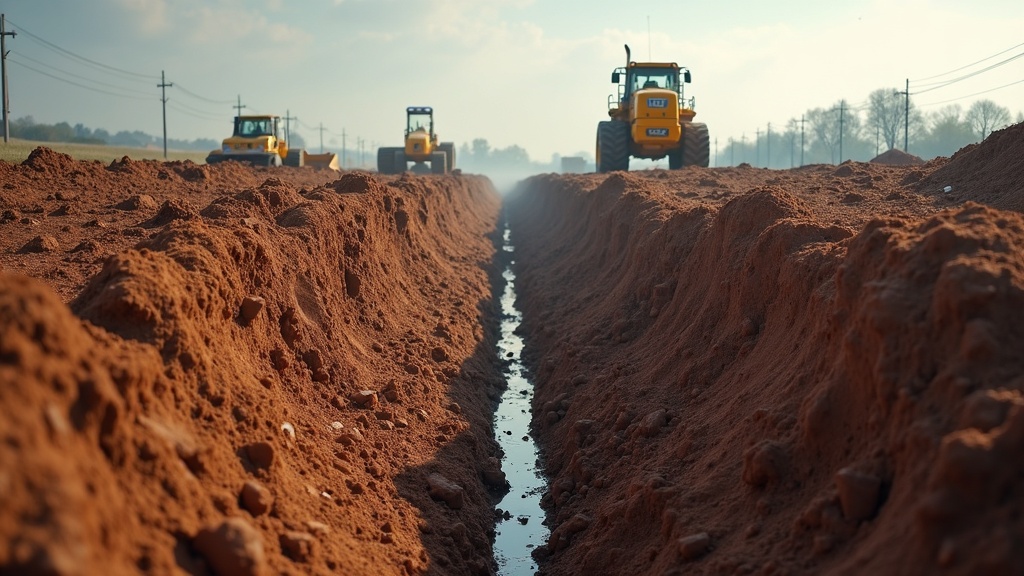
Learn how to safely and effectively backfill a trench using industry best practices, from compaction lifts and material selection to mining-specific backfill grouting applications.
Table of Contents
- What Is Backfill a Trench?
- Safety First: OSHA Requirements for Trench Backfilling
- Material Selection and Lift Thickness for Durable Backfill
- Backfill a Trench in Mining: Grouting and Ground Support
- Frequently Asked Questions
- Trench Backfill Methods: A Side-by-Side Comparison
- Practical Tips for Effective Trench Backfilling
Article Snapshot: Backfill a trench is the process of replacing and compacting excavated soil or other approved material into an excavation after underground work is complete. Proper lift thickness, compaction, and material selection are essential to prevent future settlement, protect buried utilities, and ensure long-term ground stability.
Backfill a Trench in Context
What Is Backfill a Trench?
To backfill a trench means to return excavated soil, gravel, or engineered material into an open cut after pipes, cables, or other underground infrastructure has been installed. This process is not simply dumping dirt back into a hole; it demands careful layering, moisture control, and mechanical compaction to restore the ground’s load-bearing capacity. In construction and civil engineering, the goal is to eliminate voids that could later cause surface settlement, pipe misalignment, or structural damage. In mining, the term takes on additional meaning, as operators often backfill a trench with cementitious grout to provide ground support in underground workings. Whether the project is a residential water line or a deep mine drift, the principles of lift thickness, compaction density, and material compatibility remain central to a successful outcome.
Safety First: OSHA Requirements for Trench Backfilling
Before any crew begins to backfill a trench, they must address the hazards that exist at the edge of the excavation. The United States Occupational Safety and Health Administration (OSHA) enforces strict rules to protect workers during this phase. Spoil piles and equipment must be kept at least 2 feet from the edge of the excavation to protect workers from falling materials and trench wall collapse (OSHA, 2024)[1]. This distance prevents added surcharge loading on the trench walls, which could trigger a cave-in during backfilling operations.
For any trench that reaches a depth of 5 feet or more, OSHA mandates the use of protective systems such as sloping, shoring, or trench boxes (OSHA, 2024)[1]. These systems remain in place until the backfill has been placed high enough to stabilize the walls. Crews must never remove a trench box prematurely. The backfill material itself must be placed evenly on both sides of any buried structure to avoid uneven lateral pressure. When working in mining environments, where trench depths can exceed typical construction limits, these safety protocols are even more critical and are often supplemented by site-specific ground control plans.
Material Selection and Lift Thickness for Durable Backfill
The choice of backfill material directly affects the long-term performance of the restored ground. Clean granular material shall be placed in uniform 6 to 12 inch loose layers and each layer compacted to eliminate the possibility of settlement, pipe misalignment, or damage of joints (Illinois American Water, 2024)[3]. Sand, gravel, and crushed stone are preferred because they drain well and compact to a dense, stable mass. Clay-rich soils are generally avoided for initial backfill around pipes because they retain moisture and can shift over time.
For most trenches, placing soil in 6‑inch layers and compacting each layer before adding more provides the safest and most efficient backfilling results (Caterpillar Rental Services, 2025)[5]. Some contractors use a lift thickness of 4 to 6 inches for fine-grained materials or when using hand-operated compactors. The key is to match the lift thickness to the compaction equipment. A large vibratory roller can handle thicker lifts, while a plate compactor or jumping jack requires thinner layers to achieve the same density. In mining applications, where the trench may be part of a backfill grouting operation, the material is often a sand-cement slurry that flows into place and cures without mechanical compaction, which changes the lift dynamics entirely.
Compaction Techniques for Trench Backfill
Compaction is the step that transforms loose fill into a stable foundation. Each lift must be compacted to a specified density, often 95 percent of the standard Proctor maximum dry density for general construction or up to 98 percent for utility trenches under roadways. Water content must be controlled: too dry and the particles won’t bind; too wet and the soil becomes unstable. Crews should test compaction with a nuclear density gauge or sand cone test at regular intervals. When backfilling around pipes, special care is needed to compact the haunch zones – the areas under the pipe’s sides – to prevent settling that could crack the line. For mining backfill trenches that will later support heavy equipment or serve as part of a ground support system, compaction requirements may be even more stringent, and cementitious grout is often used to achieve the necessary strength.
Backfill a Trench in Mining: Grouting and Ground Support
In the mining industry, the phrase to backfill a trench often refers to a specialized process where operators fill excavated voids with a cement-based grout to stabilize underground openings. Unlike surface trench backfilling, which relies on mechanical compaction, mining backfill grouting uses a fluid slurry that is pumped into place and allowed to cure. This technique is essential for filling stopes, drifts, and other underground voids to prevent ground collapse and to allow safe extraction of adjacent ore bodies. The backfill grout must have a specific compressive strength, usually measured in megapascals (MPa), and must be formulated to flow into narrow spaces without segregating.
One critical difference in mining backfill is the absence of lift-and-compact cycles. Instead, the grout is placed in a single continuous pour or in large batches, depending on the volume of the void. The slurry’s water-to-cement ratio, aggregate size, and additive package (such as accelerators or retarders) are carefully controlled to achieve the desired set time and final strength. When a mine needs to backfill a trench that will serve as a haulage drift or a refuge chamber, the grout mix may be designed to reach 4,000 psi or more. This is a far cry from the 6‑inch lifts of sand used in a residential sewer trench, but the underlying principle is the same: fill the void completely and create a stable, load-bearing mass. For mining operations looking to improve their backfill efficiency, resources like backfill grouting training and techniques can provide valuable guidance on optimizing slurry design and placement.
Important Questions About Backfill a Trench
What is the maximum lift thickness when you backfill a trench?
Most industry standards recommend a maximum lift thickness of 6 to 12 inches for loose material before compaction. Illinois American Water specifies 6 to 12 inch loose layers for granular backfill (Illinois American Water, 2024)[3], while Caterpillar and BigRentz both advise 4 to 6 inch layers for optimal compaction (Caterpillar Rental Services, 2025; BigRentz, 2025)[5][6]. Thicker lifts may not achieve the required density, leading to future settlement.
Can I use the excavated soil to backfill a trench?
Yes, but only if the excavated soil is free of large rocks, organic matter, and debris. Clean granular material is ideal, especially for the initial backfill zone around pipes. Clay-heavy soils should be avoided because they retain moisture and can cause uneven settling. For mining backfill trenches, native soil is rarely used; instead, a cementitious grout or a sand-cement slurry is placed to achieve structural strength.
How do I backfill a trench around a pipe without damaging it?
Place the first backfill layer in lifts of 6 to 12 inches above the pipe and compact carefully, especially in the haunch zones (the areas under the pipe’s sides). Use hand-operated compaction equipment near the pipe to avoid impact damage. Illinois American Water requires clean granular material to extend at least 12 inches above the pipe barrel before final backfill is placed (Illinois American Water, 2024)[3]. Never drop large rocks directly onto the pipe.
What is the difference between backfill a trench in construction and backfill grouting in mining?
In construction, to backfill a trench means to replace excavated soil in thin, compacted lifts to restore surface grade and support. In mining, backfill grouting involves pumping a cementitious slurry into underground voids to provide ground support. Construction backfill relies on mechanical compaction; mining backfill relies on the chemical curing of grout to achieve strength. The lift concept is replaced by continuous placement in mining applications.
Trench Backfill Methods: A Side-by-Side Comparison
Choosing the right approach to backfill a trench depends on the project type, soil conditions, and performance requirements. The table below compares four common methods used in construction and mining.
| Method | Material | Lift Thickness | Compaction | Best For |
|---|---|---|---|---|
| Mechanical Compaction | Granular soil, sand, gravel | 4–6 inches | Plate compactor, jumping jack, vibratory roller | Utility trenches, road bases, residential work |
| Water Settling | Sand, fine gravel | 12–24 inches | Water jetting (flooding) | Non-structural fills, remote areas |
| Flowable Fill (CLSM) | Cement, fly ash, sand, water | Full depth (single pour) | Self-leveling, no mechanical compaction | Narrow trenches, bridge abutments, mining |
| Mining Backfill Grouting | Cement, aggregate, water, additives | Full void (continuous pour) | Cures to structural strength | Underground mine stopes, drifts, ground support |
Practical Tips for Effective Trench Backfilling
Follow these actionable tips to ensure your next project to backfill a trench is safe, durable, and code-compliant.
- Test soil moisture before compaction. The optimum moisture content for most soils is around 8 to 12 percent. Too dry and the fill won’t bind; too wet and it becomes unstable. Use a handheld moisture meter or send samples to a lab.
- Use the right equipment for the lift thickness. A plate compactor works well for 4-inch lifts of sand, while a vibratory roller is better for 6- to 12-inch lifts of gravel. Never use a large roller on thin lifts over a pipe.
- Compact the haunch zones first. When backfilling around a pipe, place and compact material under the pipe’s sides before filling above. This prevents the pipe from settling and cracking.
- Consider flowable fill for narrow or deep trenches. Controlled low-strength material (CLSM) is self-leveling and requires no mechanical compaction, making it ideal for tight spaces or where worker access is limited.
- In mining applications, test the grout mix design. Before you backfill a trench in an underground mine, run a trial batch to confirm the slurry’s flowability, set time, and compressive strength. Adjust the water-to-cement ratio and additive package as needed.
- Document compaction test results. Keep records of nuclear density gauge or sand cone tests for each lift. This documentation is often required by the project engineer or regulatory agency.
Key Takeaways
To backfill a trench correctly requires a methodical approach: select the right material, place it in thin lifts, compact each layer thoroughly, and follow safety regulations. In mining, the same principles apply but with cementitious grout replacing mechanical compaction. Whether you are a general contractor or a mining engineer, understanding these fundamentals will help you achieve stable, long-lasting results. For more detailed guidance on mining-specific backfill grouting, explore the backfill grouting training and techniques and other resources available on our site.
Useful Resources
- Trenching and Excavation Safety Fact Sheet. Occupational Safety and Health Administration (OSHA).
https://www.osha.gov/sites/default/files/publications/trench_excavation_fs.pdf - Section 31 23 33 Trenching and Backfilling. Illinois American Water.
https://www.amwater.com/ilaw/resources/PDF/about-us/Engineers-Contractors/Sewer/31_23_33_Trenching_and_Backfilling.pdf - Trench Backfilling Tips for Safety and Efficiency. Caterpillar Rental Services.
https://rent.cat.com/en_US/blog/tips-backfilling-trenches.html - Trench Backfill: Best Methods & Materials, Ultimate Guide. Machines Learning Construction Guide.
https://www.machinesl.com/trench-backfill/ - 4‑Step Guide to Backfilling Trenches and Foundations. BigRentz.
https://www.bigrentz.com/blog/backfill-trench